
- Home
- »
- Philippines
- »
- Bohol
- Basel BSL
- Berlin BER
- Bremen BRE
- Dresden DRS
- Düsseldorf DUS
- Frankfurt FRA
- Hamburg HAM,
- Hannover HAJ
- Köln CGN
- Leipzig LEJ
- München MUC
- Norddeutschland HAM,HAJ,BRE
- Nürnberg NUE
- Ostdeutschland LEJ,DRS,BER
- Schweiz ZRH,BSLGVA
- Stuttgart STR
- Süddeutschland MUC,NUE,STR
- Westdeutschland DUS,CGN,FRA
- Wien VIE
- Zürich ZRH
- Österreich VIE,
- All board types
- Room only OV
- At least breakfast F
- At least half board HP
- At least full board VP
- At least all inclusive AI
- All inclusive plus AI+
- All board types
- Room only OV
- At least breakfast F
- At least half board HP
- At least full board VP
- At least all inclusive AI
- All inclusive plus AI+
Bohol
At approx. 4,200 sq km, Bohol is the tenth-largest island of the Philippines and belongs to the Visayas group. It is surrounded by another 61 smaller and tiny islets and sandbanks. Bohol is sheltered between the larger island of Cebu to the north-west and Leyte to the north-east and has a topography unique in the Visayas group. The South China Sea with its warm water on one side and the Pacific Ocean on the other have, over the course of evolution, gathered and produced an enormous diversity of underwater vegetation. With its crystal-clear water, Bohol is an El Dorado for water sports. The locals fondly call the island of Bohol God’s little paradise.
Panglao is connected to Bohol by two bridges about 50 metres long. All the beach resorts are on Panglao, with its white sandy beaches and clear sea water.
The small island of Cabilao, 7.2 sq km, lies between Cebu and Bohol in the middle of the central Visayas. The crystal-clear water and the fringing reef are ideal for diving and snorkelling. There are only a few motorbikes on the island, which are used for transport.

Diving
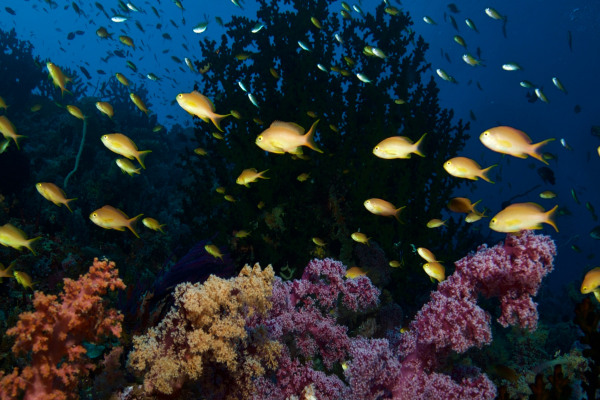
Diving around Bohol is very varied and offers beautiful coral gardens even in shallow water. Highlights include the numerous walls with caves, overhangs and crevices. The fascinating underwater landscapes, especially the gorgonians, soft corals and the many colourful feather stars, provide a home for nudibranchs, anglerfish, snake eels, scorpionfish and sea snakes. The dives around Balicasag and Cabilao Island are particularly beautiful. Diving is possible all year round, the best time is from November to May. Tips: the months February to May are considered whale shark season
Getting there
Arrival Bohol/Panglao/Cabilao: You fly either directly to Cebu International Airport or via Manila to Tagbilaran.
Arrival in Cebu: You will then be taken to the harbour, where the ferry – a large passenger catamaran – is waiting for the crossing to Bohol. After about 90 minutes you reach Tagbilaran, the capital of Bohol. From here you will be driven by taxi or minibus to your booked resort.
(If your flight arrives after 17:00 local time, an overnight stay in Cebu is necessary, as the last ferry leaves Cebu at about 18:00)
Arrival in Tagbilaran: on arrival at Tagbilaran airport you will be picked up and driven by taxi or minibus directly to your booked resort.
