
- All board types
- Room only OV
- At least breakfast F
- At least half board HP
- At least full board VP
- At least all inclusive AI
- All inclusive plus AI+
Venice
Venice is the capital of the Metropolitan City of Venice, which emerged from the Province of Venice on 1 January 2015. The city of Venice comprises the historic centre, covering 646.80 hectares on 127 islands (list of the old-town islands of Venice), as well as most of the Venetian Lagoon with its more than 60 islands.
The settlements from which Venice grew lie on alluvial land deposited by post-glacial rivers. The lagoon that formed in their estuary covers an area of about 550 km² and is separated from the Adriatic by sandbars roughly 60 km long. Islands cover only about three percent of this area; the rest consists of tidal flats and marshland, the barene, which cover more than 90 km², plus around 92 km² of fishing grounds, the valli da pesca. The barene are criss-crossed by natural channels known as ghebi.
Around 1300, the Venice of the lagoon alone probably had about 85,000 to 100,000 inhabitants, a number that rose rapidly and may have reached 140,000 before the first wave of plague in 1348. Around 1600 one can reckon with roughly 150,000 to 160,000 inhabitants, but the 200,000 mark was probably never exceeded.
Fly from international airports to Marco Polo Airport. From there, two bus connections run to the centre of Venice: the ATVO Express bus for €8 one way with a journey time of just 20 minutes, or the ACTV city bus, which takes 35 minutes and costs €8 one way.
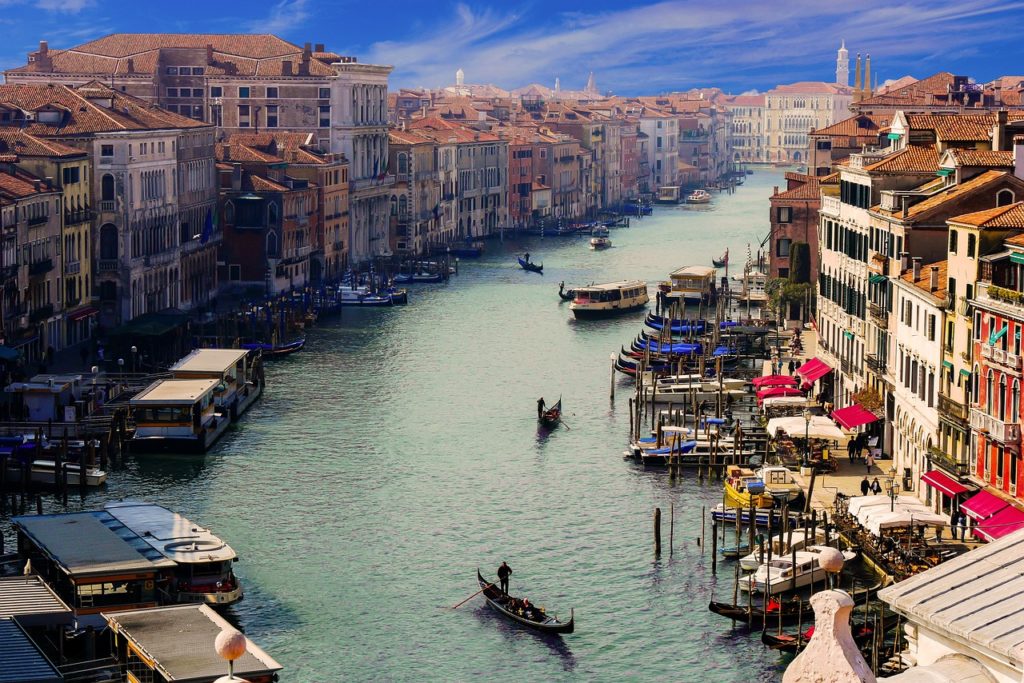
Venice is the capital of the Veneto region in northern Italy and was built on more than 100 small islands in an Adriatic lagoon. There are only a few streets and almost exclusively canals, including the Grand Canal with its Renaissance and Gothic palaces. On central St Mark’s Square stands St Mark’s Basilica with its Byzantine mosaics and the bell tower, from which the view stretches across the red roofs of the city.
